

Gibson’s humanities lecture explores power, authority in Stanford Prison lecture
 Power can change people in unexpected ways.
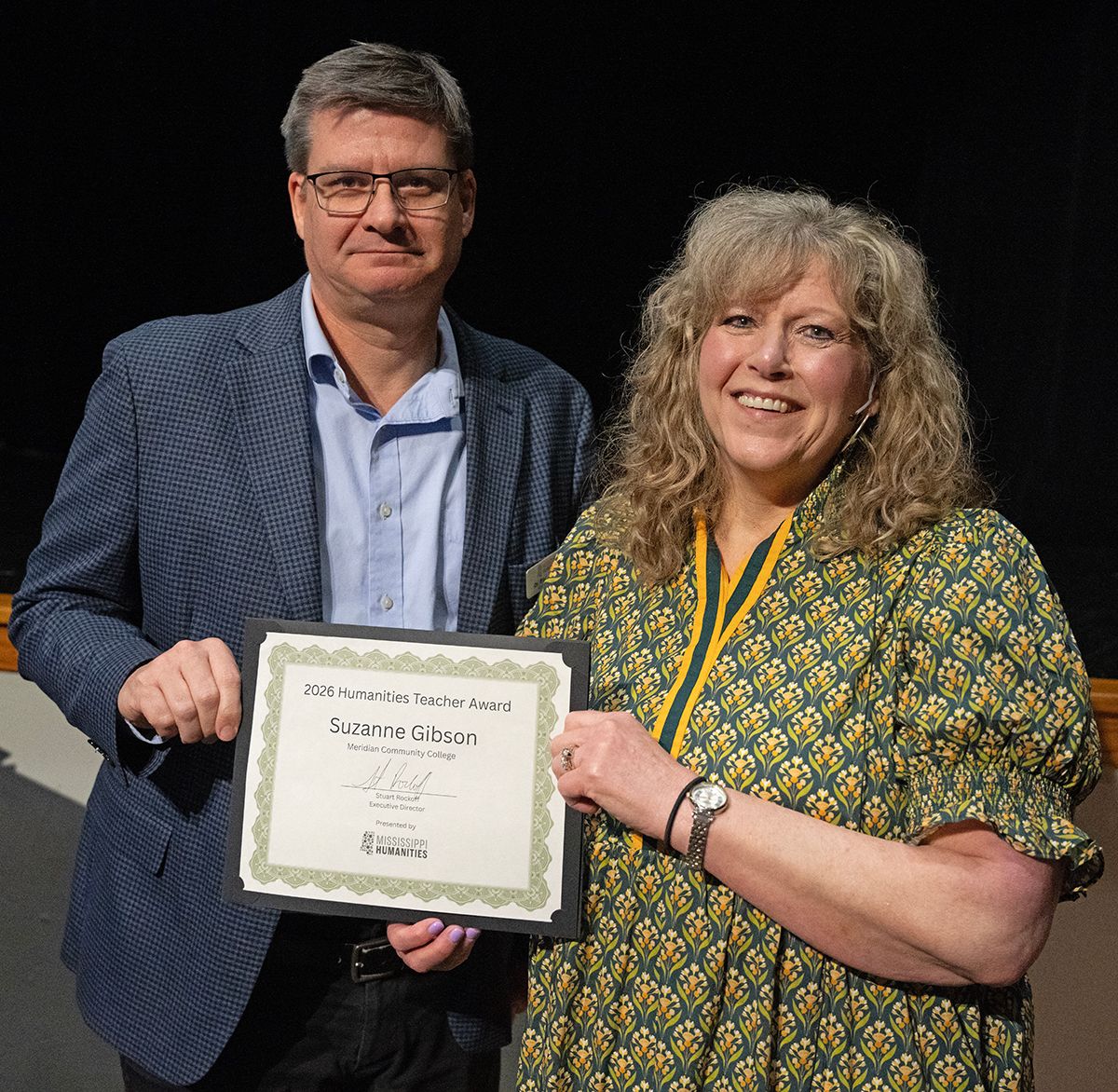
That was one of the messages Suzanne Gibson shared Friday morning as Meridian Community College honored her as its 2026 Humanities Teacher of the Year. Gibson, a psychology instructor and division chair of social sciences and business, presented her lecture, “Roles, Obedience, and Authority: An Examination of the Stanford Prison Experiment,” during a program at McCain Theater.
The Mississippi Humanities Council sponsors the award and recognizes outstanding humanities faculty at colleges and universities across the state. Gibson will also be honored at the council’s Public Humanities Awards Ceremony in Jackson later in March.
Her talk examined the 1971 Stanford Prison Experiment, a psychology study led by Stanford University professor Philip Zimbardo. The project was designed as a two-week simulation of a prison where college students were assigned roles as guards or prisoners. The experiment ended early when the guards’ behavior toward the prisoners became abusive.
“The Stanford Prison Experiment has always been fascinating to me,” Gibson said. “I never understood why the prisoners didn’t just say, ‘You cannot treat me like this,’ or why the guards had to be so cruel. That pushed me to look deeper.”
Gibson encouraged the audience to think about how systems and authority shape behavior. She asked what might happen if ordinary people were placed in stressful roles with power over others.
“Just being in an authoritative position does not make it okay to mistreat others,” she said. “Sometimes we need to change the system or situation for the better.”
In one slide, What Can We Take Away From This?, Gibson outlined key lessons. She said the environment influences how people treat one another. She urged audience members to treat others with respect, even in difficult moments. She also said the study, though criticized for flaws, serves as a warning about the dangers of unchecked authority.
Dr. Stuart Rockoff, executive director of the Mississippi Humanities Council, presented a certificate to Gibson and noted her lecture raised questions about ethics, morality, and how society explains harmful behavior.
“It was very thought-provoking,” Rockoff said. “Humanities education and educators are so important, and that is why we celebrate them through this program.”
For more information, visit meridiancc.edu.