

Rushing challenges E.L.C. members to know themselves, keep growing
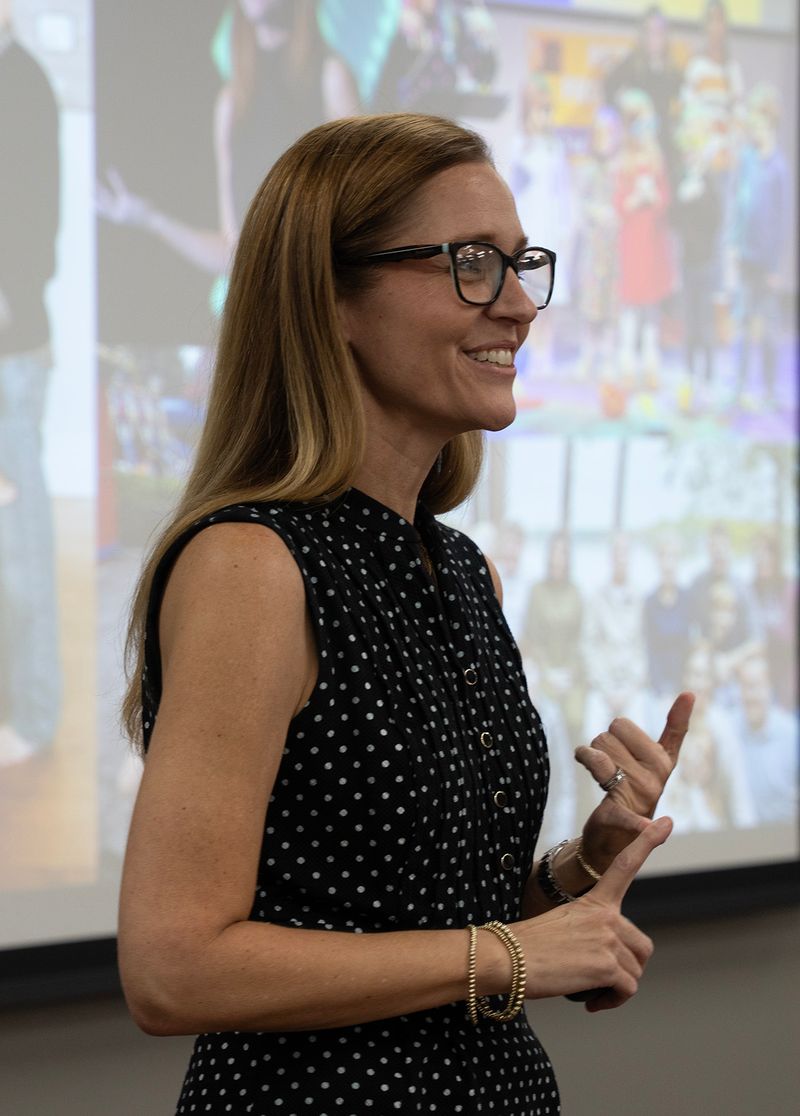 Leadership starts with knowing yourself.
Kassi Rushing brought that message to Meridian Community College’s Eagles Leadership Convocation (E.L.C.) Class of 2027 during a recent session focused on communication, self-awareness, and the ways people lead.
Sponsored by the MCC Foundation, E.L.C. is a College-based professional development program that strengthens leadership, communication and teamwork skills while helping employees build connections across campus.
The Class of 2027 includes Mya Adams, Heather Ammon, Mark Brentnall, Anthony D’Angelo, Marquita James, Will Nathan, Janet Parrett, Brandi Pickett, Tracy Stockton, and Erica Stokes.
Rushing, director of organizational strategy and team member experience at Blue Hen Agency, told participants there is no single model for effective leadership.
“There’s no such thing as one way to be a leader,” Rushing said.
People bring different strengths, habits and communication styles to their work. Understanding those differences can help leaders connect with others, work through conflict and build stronger teams.
“Leadership’s not a position. It’s a posture,” Rushing said. “It’s something we choose.”
Participants used the DISC behavior assessment to examine their own communication and behavioral styles. Rushing described DISC as one tool that can help people understand not only how they see themselves, but how others may experience them.
That awareness matters because a leader’s natural tendencies can sometimes become barriers.
The goal, Rushing said, is to recognize those tendencies and decide when a different approach may be more effective.
“The DISC activity was a wonderful exercise that helped me learn more about myself and others,” said Pickett. “The behavioral assessment showed that I naturally focus on building relationships, encouraging others, and creating a supportive team environment,” she said.
“I also learned that understanding different personality styles can help me communicate more effectively, work better with others, and become a stronger leader,” Pickett added.
Parrett echoed those thoughts about Rushing’s presentation. “We were able to learn about our own styles and how to communicate best with people who might want fewer details and with people who wanted the good mornings and extra details,” she said.
Rushing also challenged participants to view leadership as a skill that requires practice.
She compared it to going to the gym. Everyone has muscles, but they grow stronger only when they are exercised. Leadership requires the same kind of continued attention.
“You have to keep working,” Rushing said.
That need for growth does not disappear when someone earns a title or spends years in a leadership role. Rushing said leaders can actually become less self aware over time because people may become less willing to challenge them or offer honest feedback.
A leader may hold the same position for years, she said, but the environment around that position keeps changing. Goals change. Teams change. Expectations change.
Leaders have to keep changing, too.
Rushing said that lesson is becoming even more important as artificial intelligence changes the workplace.
Technology can handle more technical and routine tasks, but skills such as curiosity, empathy, critical thinking, judgment, ethical decision making and communication remain distinctly human.
“We have to be more human,” Rushing said.
She is currently involved in work examining how leadership is changing in the age of AI and said organizations are placing greater value on skills that technology cannot easily replace.
“AI will never lead us,” Rushing said. “We have to have humans in the lead.”
Rushing has worked since 2002 in organizational strategy, workplace culture, leadership development and communication. She said sessions like the one at MCC are among her favorites because participants can immediately apply what they learn.
“The heart of this content is not just to learn something about yourself,” she said. “It’s to take what we’re going to learn and think about how we apply that in our roles.”
For more information, visit meridiancc.edu/elc.